What makes a great Veterinary Practice? We spent much of the last year separating myth from mastery. Mining data from over 8,500 emails, more than 150 teleconference hours, and a thorough examination of what Dan Ariely would describe as “Predictably Irrational” processes. Our query was simple.
Why, in a profession committed to caring, does staff “distress” (or distrust) occupy four of the top six “most perplexing” problems for veterinary hospital managers[i]? (source VHMA)
Our study included the best in every aspect of practice management from owners to techs. Professional designations ranged from DVM, CVPM, MBA, CPA, JD in every conceivable combination of professional designations.
This was not an analysis of superficial intention but substantive attention. The purpose was not to access operational effectiveness but organizational “Collectiveness”. Were practices energized by collegial collaboration or crippled by territorial separation? In a profession characterized more often as a calling than a career, is the most prolific pathology found not in our patients but our patience?
To be clear our focus was not on the zoological components of veterinary practice management – but we found ourselves overwhelmed by the infinite pathologies in interpersonal entitlement.
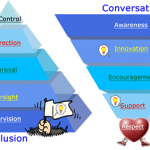
Our admittedly unscientific research was profoundly revealing in the absence of “We”. Organizational designs favoring hierarchical systems of command and control rated highest in disrespect using “I” over “We” with frightening frequency.
With further analysis based on research published by Dr. David R. Hawkins, M.D., Ph.D. in
Power vs. Force, The Hidden Determinants of Human Behavior, each communication was assigned a positive or negative engagement value. Scored on an EQ range from energizing and engaging to demeaning and demoralizing.
Using the correlation between the Emotional Intelligence of communications and the EQ of cultures we extended our analysis to the “currents” of their respective communities.
Were cultures:
- Competitive or Collaborative
- Authoritarian of Inclusive
- Egotistical or Evolved
- Honest or Evasive
- Secure or Superficial
- Creative or Controlling
- Inspired or Afraid
The differences were evidenced in both ideology and architecture. Those whose systems were all-inclusive, non-coercive, totally-transparent and continuously collaborative earned the highest levels of engagement, lowest turnover and top-tier customer satisfaction. The difference was not found among those that had the greatest technological expertise but those whose respect for all created a culture of caring.
Bill Kearley, DVM, MBA, a former practice owner who has worked in practice management consulting and coaching for the last 12 years, sums it up best when he teaches his clients . “How you’re treated and respected and how you’re valued in the practice is the most important thing—and it’s really the cheapest, just showing people respect and recognition.[ii]”
We don’t have all the solutions. In fact to mirror the introduction of Vineet Nayar as CEO of HCL Technologies we may not even know the right questions. We are happy to be wrong in our insights and have started a place to learn and debate, discern and create. We considered creating a specific group for those within the veterinary profession but believe that institutional myopia is part of the problem. Every industry that depends on the innovative engagement of all stakeholders can benefit from international trends towards more inclusive, sustainable and respect-full workplaces.

Join the conversation in our just getting started LinkedIn group Peer Powered Performance.
[i] http://veterinarybusiness.org/practice-management-news-views-around-world-april-2014/
[ii] http://veterinarynews.dvm360.com/jobs-report-turnover-veterinary-hospitals-might-worsen-economy-improves-study-says?pageID=2
Share


 Follow